
Make America Third Reich Again?: Historical parallels of power (Part I.)
Silence is complicity. Language is the last defence of truth. This is not radicalisation, but a refusal to ignore historical parallels. As Václav Havel wrote, power thrives when we look away.

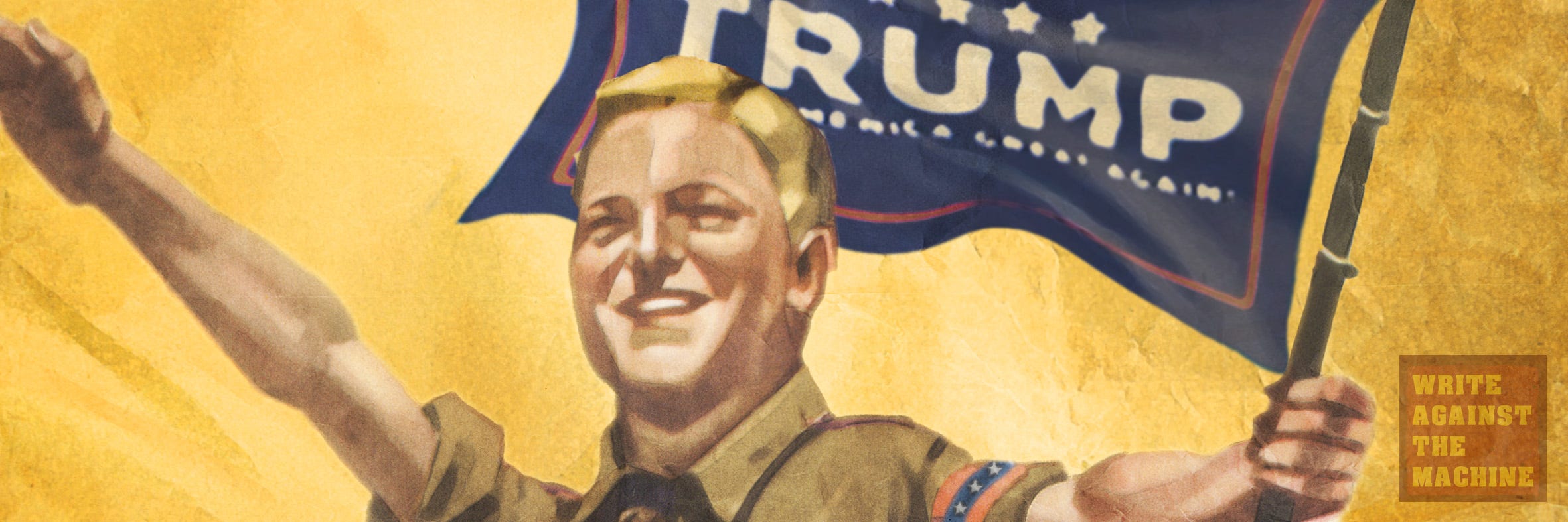
An inner imperative leads me to write these lines - to stand against obvious evil in its early stages - not from a desire to radicalize, but from a simple need not to look away where silence becomes complicity. I do so in the spirit of Václav Havel’s legacy and his essay The Power of the Powerless. In a situation where lies become the norm and violence becomes rhetoric, the word remains the last and strongest tool for defending human integrity. It is up to everyone how they act when their neighbor disappears, or whether they support the growth of evil through silent consent.
Dust off the basics of recent history with me and let yourself be guided through an image of patterns and parallels of current events in the context of Nazi ideology and major historical events from the perspective of a European who has these historical experiences deeply rooted in the nation’s cultural memory. I supplement subjective interpretations with direct quotes — not as proof, but as an anchoring in reality (historical and contemporary).
„Those who cannot remember the past are condemned to repeat it“ (George Santayana, The Life of Reason, 1905)
For a general overview, it is enough to list a few key figures. The entire Nazi ideology begins with the figure of Helena Blavatsky (1831–1891) and her Theosophical Society, which laid the occult foundations. Guido von List (1848–1919) added a pseudo-historical theory of a chosen Aryan race to Blavatsky’s secret knowledge. Radicalization continued through Jörg Lanz von Liebenfels (1874–1954), founder of the magazine Ostara, which was the mouthpiece for the struggle for racial purity and became an inspiration for Adolf Hitler in his Mein Kampf. In the proto-Nazi era, Rudolf von Sebottendorff (1875–1945) founded the Thule Society, which combined previous ideas, and its members later founded the DAP, the predecessor of the NSDAP (Nationalsozialistische Deutsche Arbeiterpartei) under the leadership of Adolf Hitler.
Key figures of Nazi ideology that I will put into context were the propagandist Joseph Goebbels, SS commander and devoted ideologue Heinrich Himmler together with Reinhard Heydrich, and the commander of the SA paramilitary units, Ernst Röhm. Nazi ideology was a mixture of inconsistent trends: from primitive hatred to pseudo-mythological constructs and intellectually masked argumentations. Similarly today, the eclectic mix of the MAGA movement and the pseudo-intellectual visions of “Dark Enlightenment” by Curtis Yarvin resonates, whose ideas gained influence thanks to the support of Peter Thiel. Both cases of ideologies share a similar goal: the erosion of existing structures and their replacement with a system that prefers absolute control over a democratic balance of power.
Adolf Hitler vs. Donald Trump
Hitler’s narratives are widely known. At first, he acted as a rebel against the rotten system of democracy, arguing over beer that a global conspiracy of Jews was responsible for Germany’s loss. However, the basic theses are a direct parallel to the MAGA movement around Donald Trump. Hitler created an internal enemy within society. He spread lies and conspiracy theories about a global Jewish conspiracy responsible for Germany’s surrender in the First World War. He called for the demolition of the existing democratic system as dysfunctional and rotten. He placed himself in the role of the only leader who would lead the nation back to its deserved glory - the thousand-year Reich.
Similar parallels can be noted in statements about restoring the lost glory in the slogan “Make America Great Again” - which is not even Trump’s invention; historically, the first person to use this slogan was Ronald Reagan. He finds the internal enemy in the form of immigrants. A global enemy in the form of the whole world that plunders the American domestic market and must be defended against with tariffs. Parallelisms are more than this article can carry, so I have limited them only to the most obvious ones and supplemented my subjective views with real quotes in context.
Hitler’s narratives are well known. On the beginning, he acted as a beer-hall rebel who blamed the global Jewish conspiracy for Germany’s humiliation after the First World War, especially through the Treaty of Versailles. This narrative of “lost glory” and the restoration of Germany’s great power role finds its mirror reflections in the rhetoric of the MAGA movement around Donald Trump. Trump also promises a return to the “lost glory” of America - this time, however, without a previous economic catastrophe like the Weimar Republic experienced after 1929. Both created an internal enemy. Hitler in the form of Jews, Trump in the form of migrants. Together with others, they spread conspiracy theories about a global conspiracy that “robs the nation” and the necessity to return its greatness to America.
Just as Hitler demonized democratic institutions as “rotten and dysfunctional,” Trump also calls for their weakening or even abolition. It is enough to mention Hitler’s early attacks on opposition media or purges in the academic sphere. Trump, in his second term, did not hesitate and immediately attacked basic state institutions in the form of DOGE; subsequently, his pressure on independent media began to grow, and he publicly influenced the academic independence of universities. A common feature of both is placing themselves in the role of the only (infallible) savior who will return the country’s “deserved glory” (in his case under the slogan “Make America Great Again” - ironically adopted from Ronald Reagan).
The difference in historical context, however, is the economic situation of the Weimar Republic. It went through its first hyperinflation crisis between 1918–1923; furthermore, after the Great Depression in 1929, it sank into a deep economic depression. This was characterized especially by high unemployment. In contrast, at the end of 2024, the economy in the USA was definitely not at a crisis level, although it suffered from weakened growth. Trump mainly uses the rhetoric of repeated lies and distorted numbers. A particularly favorite attack is his slogan: “All this is Biden,” but with this, he only covers up real economic problems. Developing further other possible parallels and patterns would certainly be possible, but a detailed analysis is not the goal of this article. Therefore, I move on to specific pairs of quotes.
On the poisoning of blood
Adolf Hitler (1925): „Blood mixture and the resultant drop in the racial level is the sole cause of the dying out of old cultures; for men do not perish as a result of lost wars, but by the loss of that force of resistance which is contained only in pure blood. All who are not of good race in this world are chaff.“ (Source: Mein Kampf, Chapter 11, 1925 - 1926)
Donald Trump (2023): „They let - I think the real number is 15, 16 million people into our country. When they do that, we got a lot of work to do. They’re poisoning the blood of our country, that’s what they’ve done. They poison mental institutions and prisons all over the world... They’re coming into our country from Africa, from Asia, all over the world.“ (Source: Speech in New Hampshire, 16 December 2023)
Erosion of the rule of law and the "absolute judge"
The similarities are chilling, don’t you think? Hitler almost immediately after being elected chancellor (1933) found a loophole in the law. He argued with the Reichstag fire, and that gave him the opportunity to use the Enabling Act (Ermächtigungsgesetz, 1933) and rule indefinitely without a parliament. Trump, for a change, utilized the Constitution or the National Emergencies Act (50 U.S.C. ch. 34). These are the most terrifying points of how a rule of law and the traditional democratic separation of powers can be completely eroded in an instant.
Donald Trump (2019): „I have an Article II, where I have the right to do whatever I want as president.“ (Source: Turning Point USA, July 23 2019)
Adolf Hitler: „State authority towards the people cannot be anything other than an authority independent of any other factor, because the State is to be absolute.“ (Source: Adolf Hitler, Mein Kampf, Volume 1, Chapter 10, 1925 - 1926)
The “Traitors” and seditious behavior
In November 2025, Trump publicly labeled six Democratic members of Congress as guilty of sedition (rebellion/treason). The reason was that these lawmakers called on members of the military to refuse to carry out “clearly illegal orders”. This rhetoric dangerously resembles the moment when a leader declares himself to be the law itself.
And now I will harden the tone. A quote that really terrified most people.
Donald Trump (2025): „SEDITIOUS BEHAVIOR FROM TRAITORS!!! LOCK THEM UP??? ... SEDITIOUS BEHAVIOR, punishable by DEATH!“ (Truth Social, Nov 19, 2025)
Adolf Hitler (1934): „In this hour I was responsible for the fate of the German people, and thereby I became the supreme judge of the German people... I gave the order to shoot the ringleaders in this treason.“ (Source: Speech in the Reichstag after the Night of the Long Knives, 13 July 1934)
Mechanism of power: From decrees to absolute rule
The similarities are chilling, don’t you think? Hitler almost immediately after being elected chancellor (1933) utilized a loophole in the law. He argued with the Reichstag fire, which gave him the opportunity to use the Enabling Act (Ermächtigungsgesetz, 1933) and rule indefinitely without a parliament. Trump, for a change, utilized an interpretation of the Constitution or the National Emergencies Act (50 U.S.C. ch. 34). These are the most terrifying points of how the rule of law and the traditional democratic separation of powers can be completely eroded in an instant.
Adolf Hitler: Justification of the Enabling Act (1933) „The government will make use of these powers only insofar as they are essential for carrying out vitally necessary measures... The number of cases in which an internal necessity exists for having recourse to such a law is in itself a limited one.“ (Source: Speech to the Reichstag, 23 March 1933)
Donald Trump: Article II and executive power „I have an Article II, where I have the right to do whatever I want as president.“ (Source: Speech at Turning Point USA, 23 July 2019)
When Trump spoke about why he bypasses Congress using decrees (Executive Orders), he often argued with a “broken system,” similarly to how the Nazis attacked the “talking shop” of parliament:
Donald Trump: Government through executive orders “I have joined the political arena so that the powerful can no longer beat up on people that cannot defend themselves. Nobody knows the system better than me, which is why I alone can fix it.” (Source: Republican National Convention, 21 July 2016)
Euphemism: “Nacht und nebel” vs Everglades: “The snakes are fast, but alligators [are faster]…”
When I read Trump’s statements during a visit to the Everglades detention center and heard those horrific, humiliating statements, I immediately remembered Hitler’s order from December 7, 1941, which defined the method of “special treatment” for enemies of the Third Reich. His order “Nacht und nebel” (literally Night and Fog) was a euphemism for the disappearance of people without a trace, without a trial, followed by brutal torture, mostly ending with an assignment to one of the camps where death awaited them.
I would like to mention in this context the powerful story of Noor Inayat Khan, a young woman from the UK who volunteered for the resistance; she was sent as a radio operator to France, where she significantly helped the local resistance. She was an immensely morally strong woman who underwent cruel torture in the struggle against evil and subsequently sacrificed her own life for her convictions. Therefore, Trump’s terrifyingly humiliating statements cannot leave anyone calm.
Donald Trump (2025): „The snakes are fast, but alligators [are faster]... we’re going to teach them how to run away from an alligator if they escape prison.“ (Source: During a visit to the detention center before its opening, 1 July 2025)
Parallels are certainly more numerous, but it is not the purpose of this article to examine everything in detail. However, other questions certainly intrude in this context.
Could Trump’s flirtations with Putin have the same historical connotations as the Molotov-Ribbentrop Pact?
Are the current attacks on “immigrants,” including actions against opponents, a foreshadowing of future attacks on all opponents without distinction?
Is the Everglades Detention Facility the same kind of camp as the so-called Dachau re-education camp?
Ernst Röhm vs. Steve Bannon
To promote Nazi ideas, the brute force of the SA (Sturmabteilung) units led by Ernst Röhm was needed. In the current context, this role can be assigned to the unofficial commander of MAGA (and radical sections), Steve Bannon, who also oversees MAGA actions including those of the most radical wings. Where there is a need to use force or activate attacks on opponents, he is the forming force. The “Brownshirts” from the ranks of MAGA brawlers always do their job, whether it is a loud manifesto, attacking opponents, or violent actions.
A beautiful, though not so precise, parallel is Hitler’s failed coup attempt known as the Beer Hall Putsch (1923) and the Attack on the Capitol (2021). Bannon’s statement on the eve of the attack created an expectation of a historical breakthrough among listeners.
About the struggle
Steve Bannon (2021): „All hell is going to break loose tomorrow. It’s all converging, and now we’re at the point of attack tomorrow. ... It’s not going to happen like you think it’s going to happen. All I can say is, strap in.“ (Source: Podcast War Room, 5 January 2021, the day before the Attack on the Capitol)
Adolf Hitler (1923): “The day of reckoning is coming. Either the German people will be the hammer or the anvil. We cannot wait any longer while the traitors in Berlin destroy our nation. It is time for the final struggle.“ (Source: Bürgerbräukeller, Munich, 8 December 1923)
Elizabeth Landers on the platform X (2021): “Bannon told me he plans to keep doing his podcast: “100 percent. They’ll never shut down the war room.” I also asked whether he knew there would be violence on Jan 6 when he said the day before “all hell is going to break loose.” (Source: ElizLanders on X, 15 November 2021)
About disagreements
Disagreements between Röhm and Hitler regarding the leadership of the revolution eventually led to the Night of the Long Knives (1934). Here, history has another close parallel in the disagreements between Bannon and Trump. Both men rejected the stabilization of the system. Bannon speaks of “permanent insurgency,” while Röhm spoke of a “second revolution”.
Ernst Röhm (1933): ”Adolf is a swine. He will give us all away. He only associates with reactionaries now. His old friends aren’t good enough for him. Getting matey with the East Prussian generals. They’re his cronies now. Adolf is turning into a gentleman. He’s got himself a tail-coat now. Adolf knows exactly what I want. I’ve told him often enough. Not a second edition of the old imperial army. Are we revolutionaries or aren’t we? Allons, enfants de la patrie! If we are, then something new must arise out of our élan, like the mass armies of the French Revolution. If we’re not, then we’ll go to the dogs. We’ve got to produce something new, don’t you see? A new discipline. A new principle of organization. The generals are a lot of old fogeys. They never had a new idea.” (Source: To Hermann Rauschning about Adolf Hitler, May 1933)
Bannon, in the book Fire and Fury (Michael Wolff), criticized Trump’s entourage and his family in connection with the meeting with Russians at Trump Tower, which he described as treasonous. With this, he directly attacked the integrity of Trump’s innermost circle.
Steve Bannon (2018): „Even if you thought that this was not treasonous, or unpatriotic, or bad shit, and I happen to think it’s all of that, you should have called the FBI immediately.“ (Source: Fire and Fury, Michael Wolff, 2018)
Total dominance over the battlefield: “flood the zone with shit”
Ernst Röhm (1933): „I expect that on the 1st of August, the SA will be once more ready for duty. If the enemies of the SA are hoping that the SA will not return from leave, we are ready to let them enjoy the hope for a short time. The SA is, and remains, Germany’s destiny.“ (Source: Speech in Berlin / Völkischer Beobachter, 1933)
Steve Bannon (2018): „The Democrats don’t matter. The real opposition is the media. And the way to deal with them is to flood the zone with shit. ... This is not about persuasion: this is about total victory on the battlefield of information.“ (Source: Interview with Dan Pfeiffer / Bloomberg, 2018)
Will the power of MAGA and especially the unpredictability of its radical directions eventually lead to the limitation of its power in favor of strengthening the power of its competitors? Will Bannon also be pushed out of a leadership role, as was the case with Ernst Röhm and his liquidation during the Night of the Long Knives (1934)?
Nazi ideology already had a crude rhetoric for the masses, but to appeal also to intellectual circles, it needed to have something to offer. With this, we move to the most important persons: Heinrich Himmler, Reinhard Heydrich, and Peter Thiel together with the dark figure in the background, Curtis Yarvin. I have decided to dedicate the entire next part of this article to these key figures. Because that is where what one should really fear is hidden. The last article of this mini-series will be about the genius of propaganda Joseph Goebbels vs. Tucker Carlson and Nick Fuentes.
Coming soon…
Sources:
Trump denies echoing Hitler on immigration. But it's a pattern. | AP News
Remarks by President Trump at Turning Point USA’s Teen Student Action Summit 2019
Donald Trump 2016 RNC draft speech transcript | Politico
The Guardian: Trump’s rhetoric and the ghosts of 1930s Europe
The House Select Committee to Investigate the January 6th Attack on the United States Capitol
LeMO - Living Museum Online (Deutsches Historisches Museum)
Memorial and museum - AUSCHWITZ-BIRKENAU
Institute for Contemporary History (Institut für Zeitgeschichte)
The International Consortium of Investigative Journalists (ICIJ)